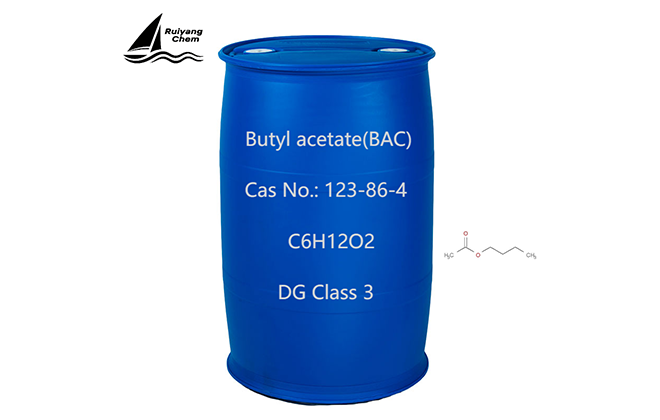
Butyl acetate (CAS Number 123-86-4) is a widely used organic solvent known for its excellent solvency, fast evaporation rate, and compatibility with a broad range of resins and polymers. Supplied in high-purity grades, it is extensively applied in coatings, printing inks, adhesives, artificial leather, and fragrance formulations.
Ruiyang Chemical supplies n-butyl acetate as part of its acetate solvent portfolio, supporting global customers with stable sourcing, strict quality control, and safe hazardous chemical logistics. Our supply model is designed to meet bulk procurement and long-term delivery requirements across multiple industries.
| Property | Specification |
| Product Name | n-Butyl Acetate (BAC) |
| CAS Number | 123-86-4 |
| Molecular Formula | C6H12O2 |
| Molecular Weight | 116.16 g/mol |
| Appearance | transparent liquid with no suspendedimpurities |
| Odor | Fruity (apple/banana-like) |
| N-butyl acetate,w/% | ≥99.5% |
| Density (ρ)/(g/cm3) | 0.878–0.883 g/cm³ |
| Boiling Point | 124–128°C |
| Flash Point (Closed Cup) | ≥22°C |
| Moisture,w/% | ≤0.05% |
| Acidity (as Acetic Acid) | ≤0.01% |
| Chromaticity/Hazen Unit (Pt-Co color scale) | ≤10 |
| Solubility | Miscible with most organic solvents; sparingly soluble in water |
To ensure the safe delivery of Butyl Acetate (BAC, CAS 123-86-4), Ruiyang Chemical supports multiple packaging options suitable for both standard and bulk chemical supply requirements:
200 L steel drums – suitable for regular orders and flexible distribution
1000 L IBC totes – ideal for medium-volume customers requiring efficient storage and handling
ISO tank containers – recommended for large-volume international shipments
All packaging units are leak-tested, corrosion-resistant, and labeled in accordance with applicable international regulations for flammable liquids. Containers are inspected prior to shipment to ensure product integrity during long-distance transportation.
Butyl acetate is classified as a flammable liquid and should be transported and stored in a cool, well-ventilated environment, away from heat sources, open flames, and oxidizing agents.
Handled by our licensed hazardous chemical logistics teams with GB-standard vehicles and 24/7 monitoring.
It is an excellent organic solvent that is widely used in nitrocellulose varnishes, in the processing of artificial leather, fabrics and plastics, as well as in the spice industry.
It is an edible spice that is accepted accordingto GB2760-2014. As a spice, it is widely used to prepare banana, pear, pineapple, apricot, peach, strawberry, berry and other essences. It can also be used as a solvent for natural adhesives and synthetic resins.
It can be used as an extractant in various petroleum processing and pharmaceutical processes.
It can be used as an analytical reagent, i.e. the reference substance - naphthalene for chromatographic analysis.
Premium Supplier Selection: We partner exclusively with top-tier domestic producers equipped with advanced automated production lines and ISO-certified quality systems.
Rigorous Quality Control: Every batch undergoes strict testing to guarantee purity ≥99.5% and compliance with international standards.
Secure Storage & Inventory Management: Professional warehousing minimizes supply disruptions.
Specialized Hazardous Chemical Logistics: Holding a national Class 1 hazardous chemical business license, we operate a dedicated fleet with customized GB-standard vehicles, real-time monitoring, and multimodal transport (road, sea, combined).
Flexible & Reliable Supply: Serving 200+ global customers with stable pricing, rapid response, and customized packaging options.
Choose Ruiyang for high-purity n-Butyl Acetate (CAS 123-86-4) backed by professional, risk-free supply chain services.
1. Do you provide food-grade or pharmaceutical-grade n-Butyl Acetate?
Yes, we can source specific grades upon request. Please specify the requirements for a tailored quotation.
2. What safety precautions should be taken when handling butyl acetate?
Butyl acetate is flammable. It should be handled in well-ventilated areas, away from heat, sparks, and oxidizing agents. Proper PPE such as gloves and eye protection is recommended, and storage should avoid direct sunlight or open flames.
3. Can Ruiyang Chemical supply bulk butyl acetate for long-term contracts?
Yes. Ruiyang Chemical specializes in stable bulk supply, supporting long-term procurement contracts. We coordinate with certified manufacturers to ensure consistent product quality and flexible delivery schedules for global customers.
4. What industries commonly use butyl acetate?
Industries include:
Paints & coatings
Printing inks
Adhesives & sealants
Artificial leather & textiles
Flavors & fragrances
Electronics cleaning and precision manufacturing



 English